The CD shift.
The transition was never about creative vision.
Three top creative directors filed their first Cruise at a new house in the same season. Matthieu Blazy at Chanel — Casino Municipal de Biarritz, 28 April. Jonathan Anderson at Dior — Wilshire Boulevard, LACMA, 13 May. Demna at Gucci — Times Square, 16 May. Each transition will be read by the trade press as the story of that brand. Read together, the three first-Cruises name an industry moment, and the moment is not about who designs the clothes. It is about which corner of the luxury sector can afford which posture right now.
The volume register is the read.
culture-watch reads Cruise shows across four registers: loud-confident, loud-pressured, quiet-confident, quiet-pressured. The four registers map the financial state of the parent group, not the creative state of the house. The trade press tends to read all three of these shows as varieties of loud — Times Square is loud, LACMA is loud, even Biarritz looks loud from the outside. They are not the same kind of loud. And one of them is not loud at all.
Read across the cohort, the three shows file at three of the four registers. Times Square is pressure-loud. LACMA is confident-loud at institutional scale. Biarritz is confident-quiet. The reason for the difference is not creative direction. The reason is the balance sheet behind the house. That is the read the trade press will not write, because the trade press reviews shows as creative events. The financial register is the structure the creative event is performing inside.
Times Square is pressure-loud.
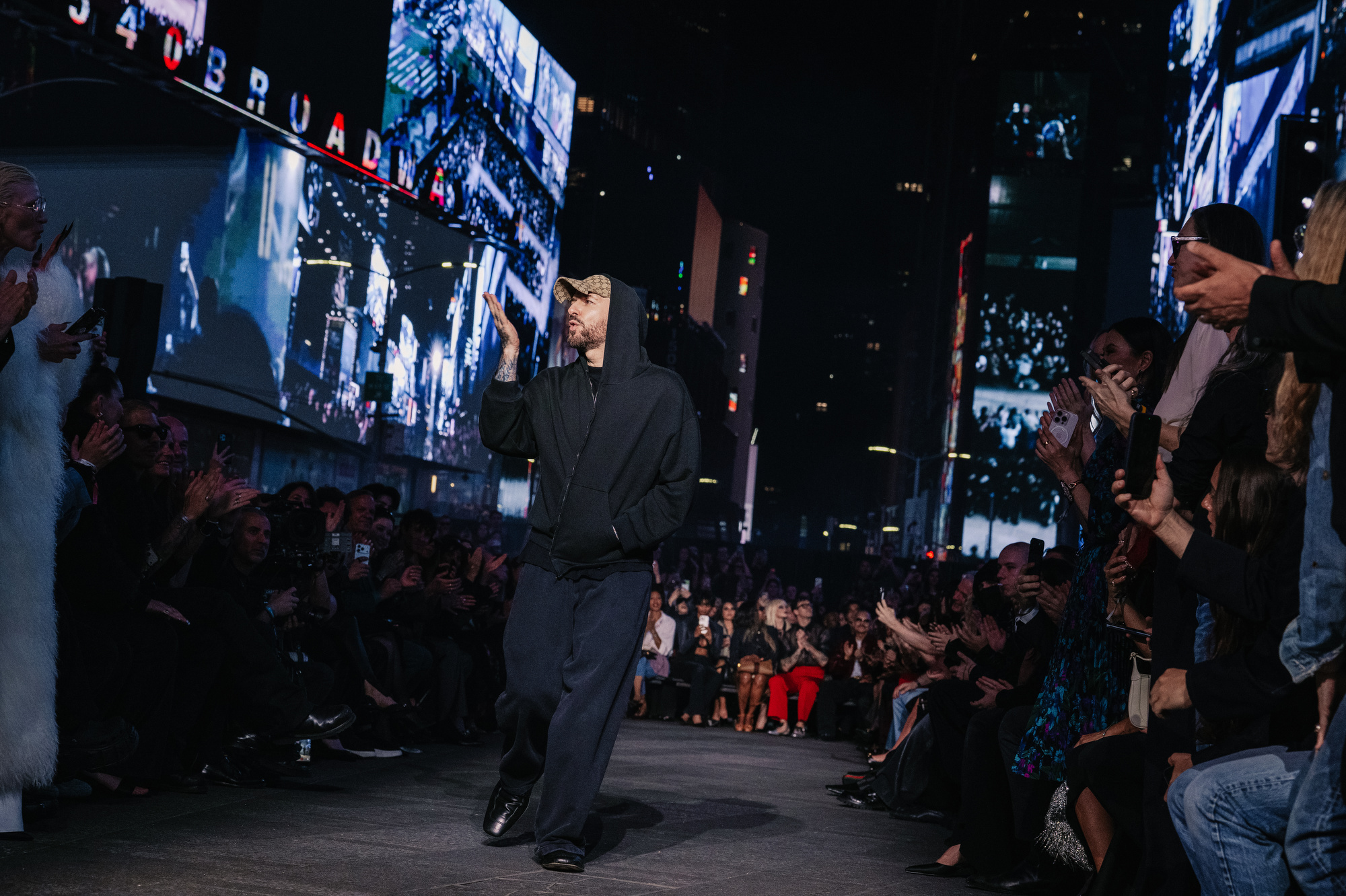
Demna shut down a full city block in Times Square. Five-address simultaneous retail. A brand film extending Gucci into supermarket produce, hotels, longevity supplements, automotive, pets. A pre-show film on the surrounding LED billboards opening on the Trevi Fountain. The closer is Cindy Crawford in feathered plumage, the second consecutive Gucci show Demna has closed with a 1990s Gucci-adjacent face after Kate Moss closed Fall/Winter 2026. The volume is unmistakable, and the volume is the read.
Gucci has been Kering's profit-pit for three years. Three creative directors in five years — Michele out, De Sarno in and out, Demna in. Kering carrying significant debt; ongoing strategic conversations about wine and auto unit spinoffs; Frédéric Arnault elevated to CEO of Loro Piana as LVMH moves its next generation into house leadership exactly as Kering needs to demonstrate the opposite. Demna's appointment is the group's last major creative-led reset before structural questions get harder to answer. Times Square is what Kering needs the market to see: scale, brand-extension imagination, and cultural attention at full volume. GucciCore as conceptual provocation is the hedge — if the commercial argument lands, the lifestyle products become real; if it does not, the brand film gives Kering cover. The five-address retail simultaneity is pressure performing as confidence. The distinction matters because confidence and pressure produce different durability profiles. Confidence compounds. Pressure has to keep performing.
The clothes are still catching up. His SS26 RTW debut was moved from its original March 2026 slot to September 2025 — a six-month development window compressed by the same quarterly logic the show is designed to answer. Demna himself shows the result: the construction grammar splits into roughly equal thirds — Demna ports from Balenciaga, Michele archive activation, Tom Ford body-consciousness. This is a CD who has read the house. He is not yet authoring it. The brand argument and the casting argument carry the show. The clothes carry the gap. That gap is what Kering's quarterly cycle cannot sustain indefinitely, and the part the market will read first when the next earnings call comes.
LACMA is institutional-loud.
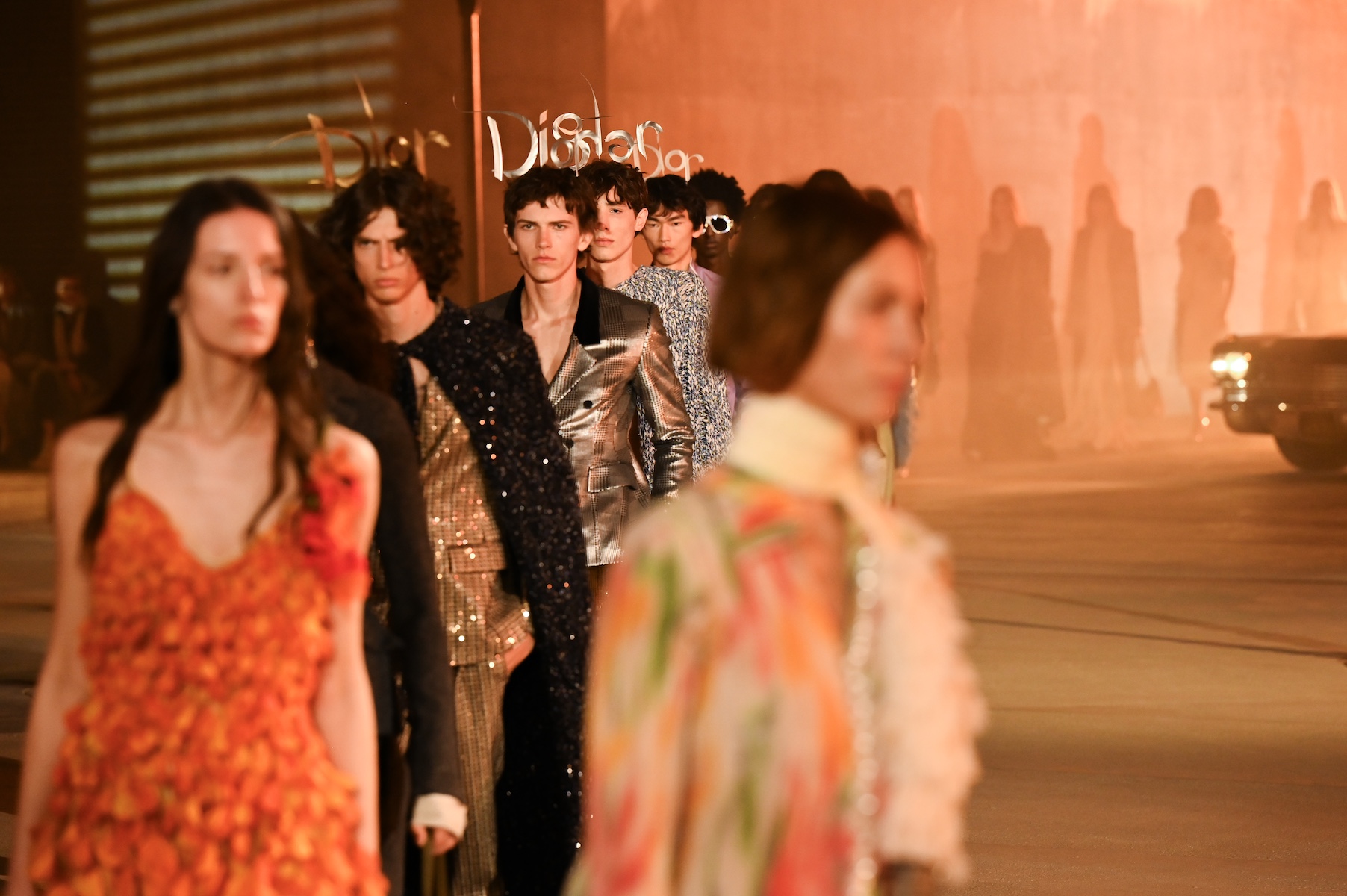
Anderson built a Los Angeles intersection inside Peter Zumthor's new David Geffen Galleries — the most consequential American museum commission of the decade. Vintage Cadillac fleet color-coded to the palette. Fog in the final sequence. 75 looks across men's and women's, the first mixed-gender Cruise in Dior's format. The 17-name front row is not contemporary celebrity casting; it is Dior's documented Hollywood archive activated — Pacino, Cyrus, Carpenter, Jisoo, Goldblum, Taylor-Joy, Tracee Ellis Ross, Macaulay Culkin, Miranda Kerr. Anderson recovers the 1949 Bar jacket Christian Dior made for Marlene Dietrich for Stage Fright, the prototype held in the Alaïa archive until this year. Luca Guadagnino has been filming Anderson over the past seven months for a documentary chronicling his arrival at Dior. The LACMA show is itself one of its scenes.
This is loud and it is not pressured — it is the volume LVMH uses when it wants the market to see its operational depth. The difference between LACMA-loud and Times Square-loud is that one is communicating capacity and the other is communicating need. The market reads both registers. They are not interchangeable.
LVMH does not have Kering's debt profile. Dior is the second-largest pillar in the group's fashion architecture behind Louis Vuitton. Pietro Beccari ran Dior from 2018 to 2023 through its biggest growth window in the house's history, then moved up to CEO of Louis Vuitton in 2023 and is widely reported to be in line for greater LVMH group responsibility. The Anderson appointment is the next leg of that arc. Dior is being staged as a cultural institution — LACMA, Zumthor, Guadagnino documentary, the 1947 California archive — because LVMH does not need Dior to perform commercial spectacle. The group needs Dior to anchor the next round of growth-investor messaging as the cultural-depth play. Anderson is the antidote to the late-Chiuri politics fatigue that capped the brand's growth ceiling — politics out, craft in, as the handwritten-script headpieces spelling DIOR, STAR, FLOW, BUZZ make literal. Only male-presenting models wore them. The destroyed-denim system inside Dior Women's is calibrated for the under-35 customer LVMH cannot afford to lose to Loewe-without-Anderson or to Hermès-as-usual.
The casting tells the same story. Ashley Brokaw — long-time Anderson collaborator from his Loewe years, book runs Prada / Proenza Schouler / Ghesquière at Louis Vuitton — is not the Loewe casting team. Anderson is not importing his prior infrastructure wholesale; he is recalibrating for Dior scale. That recalibration is what LVMH bought. A CD who reads the house he is entering and builds from there rather than arriving with a finished argument is the operational posture the group's financial register requires.
Biarritz is confident-quiet.
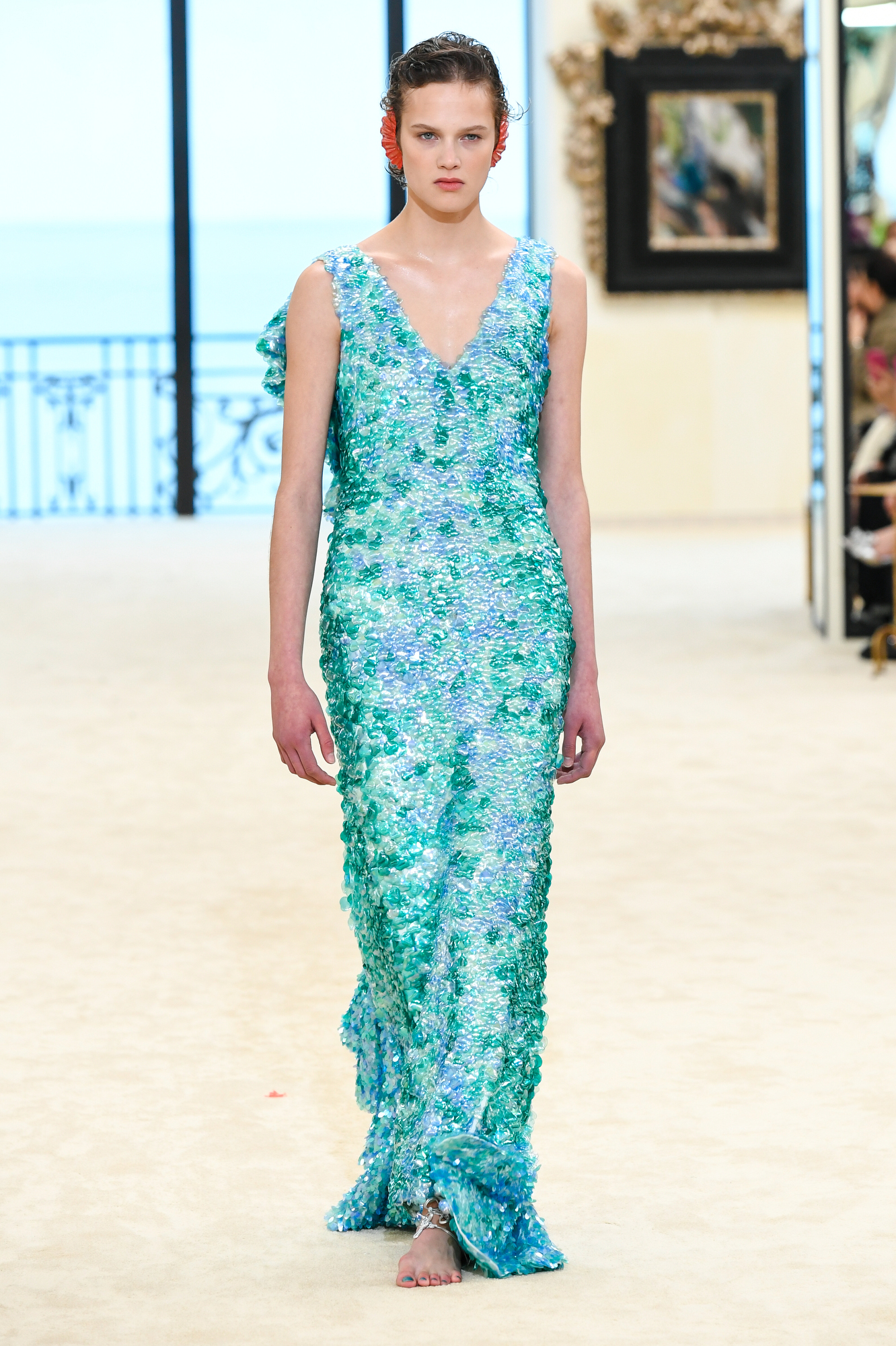
Blazy's first Cruise for Chanel is the only one of the three that does not perform commercial signal. No same-night retail. No buy-now mechanism. No online capsule timed to the show. Instead: an ephemeral summer 2026 boutique inside the Villa de Larralde — Coco Chanel's actual 1915 couture house, two blocks from the Casino Municipal — and a Métiers d'Art 2027 announcement for Rome. Demand at Chanel boutiques is already structurally outpacing supply across Blazy's first three collections. The commercial pressure is removed from the show itself because the conversion is already overheated. The show does not need to function as a conversion event. That removal is itself the signal.
The 79-look volume is dense, not loud. The runway is professional-model-only against a galactic celebrity front row — Kidman, Cotillard, Casiraghi, A$AP Rocky, Swinton, Coppola, Coel, Vartolomei, Elsesser. Anita Bitton casts the runway as she did at Bottega under Blazy: sculptural, professional-first, celebrity walkers used sparingly and only as craft anchors.
Blazy has not put a celebrity on the Chanel runway across any show — not at SS26 RTW, not at Couture, not at Cruise 2027. The celebrities are in the front row. The runway is professional-first throughout. That distinction is not incidental. The celebrity walker is a commercial signal — it tells the market the house needs the name to move the clothes. At Gucci, Cindy Crawford closes. At Chanel, Cindy Crawford does not exist on the runway. That gap is a financial read, not an aesthetic preference. Chanel does not need the celebrity to perform commercial intent. The runway is the argument. The front row is the witness.
Chanel is private. The Wertheimer family does not have to satisfy quarterly earnings calls, growth investors, or debt-service obligations. Blazy is the first major creative director poached from Kering by a private house in a decade. The Bottega → Chanel move is the talent battle Kering just lost in the most visible possible way, and the most visible way to lose it is to lose it to a house that will never have to justify the hire to a shareholder. The Biarritz play is not archaeology for archaeology's sake; it is claiming a permanent geography outside Paris that Kering cannot replicate at Bottega under Louise Trotter. Demand outpacing supply is the one condition the luxury sector cannot manufacture by spending more. It is the only posture that is genuinely unavailable to a pressured competitor.
The pattern across the three.
Read together, LVMH is staging institutional depth, Kering is staging commercial spectacle, and Chanel is staging the strategic patience neither of them can currently afford. The three first-Cruises of the season name three completely different financial states using the same calendar slot and the same format. The trade press will read them as three takes on luxury under three new directors. They are three corners of the luxury sector showing their hand in the same Cruise season, and the hand each one is showing is determined by the balance sheet, not the brief.
Each CD has been hired into a register he can actually deliver. Anderson is operational and craft-minded — LVMH bought operational depth. Blazy is sculptural and patient — Chanel bought the writer who can refuse celebrity at the celebrity-saturated house. Demna is louder than the room and historically commercial — Kering bought the brand-extension imagination it needs to refloat Gucci. None of the three CDs would deliver at the others' houses. The match between CD and parent group's financial register is more load-bearing than any single creative decision in any of the three shows. That match is what gets negotiated before the first sketch is drawn.
The casting reads the same pattern in miniature. Anderson appoints a returning collaborator recalibrated to Dior scale — operational continuity. Blazy keeps his casting director and uses her exactly as he did at Bottega — strategic continuity. Demna ports his Balenciaga celebrity playbook to Gucci — commercial continuity, scaled up. Each CD's casting decision is legible only against the parent group's financial register, not against the brand's archive. The casting is not a creative decision. It is a financial posture expressed through a creative decision.
The clothes confirm it. Anderson's destroyed denim plus 1949 Bar jacket recovery is heritage-customer reactivation calibrated for the LVMH growth-investor narrative. Blazy's archive-recovery plus mermaid invention is the structural permission to not over-perform. Demna's equal-thirds construction split is a CD who has read the house at the speed Kering's quarterly cycle could permit, and not faster. In each case, the clothes are not the argument. The clothes are the evidence of the argument the parent group is making.
The era this is naming.
Three transitions in one season is not an accident of calendar. It is the visible expression of an industry under structural reorganization. The luxury sector spent the last fifteen years scaling — celebrity ambassadorships, drop culture, social-first commerce, expanded category ladders. The CD transitions of 2024 and 2025 are the first round of post-scale CDs, hired against the actual financial state of their houses rather than against the scale-era playbook. The era is naming itself in the houses' inability to all reach for the same posture.
LVMH can afford institutional. Private Chanel can afford patience. Kering has to perform spectacle. Hermès does not change. Richemont's softer luxury houses — Loewe-without-Anderson, Bottega-under-Trotter — are running quieter than they used to because the operational logic is now LVMH's by default. The independent houses built on Instagram-era growth are working with a different ruleset entirely and will probably write the most interesting reads of the next three years.
That is the cohort. Three first Cruises. Three financial states. Three corners of luxury exposed across the same Cruise season. Each of these CDs entered their house mid-cycle — and Cruise 2027 is the first collection all three built from a standing start, without predecessor shadow, inherited orders, or compressed timeline. The financial register reads so clearly because, for the first time, the choices were entirely theirs. The trade press will write three reviews.