Gucci.
Gucci takes New York.
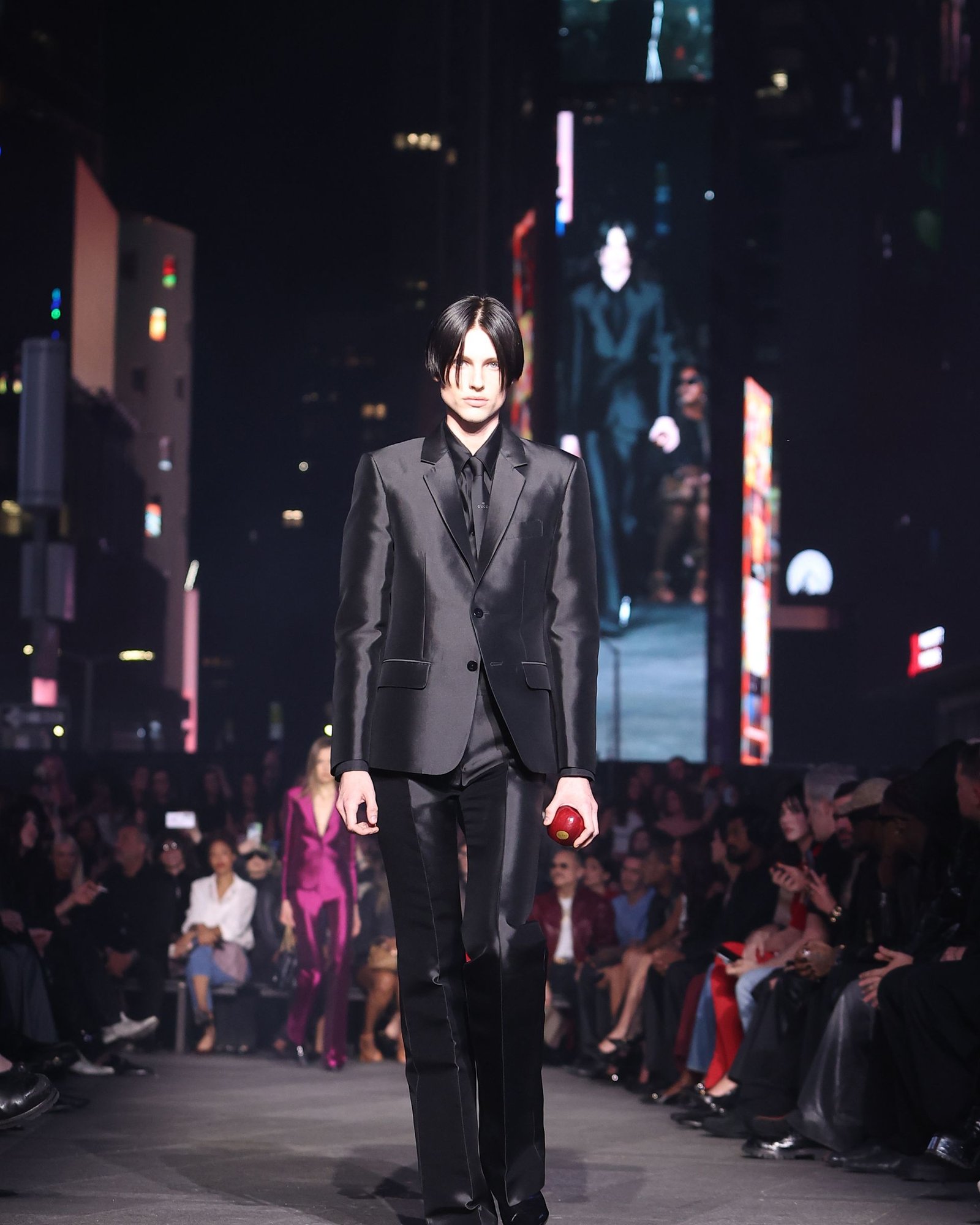
Demna's first Gucci Cruise files three operational arguments under one geographic claim. The opener walks a male model in a full black satin suit carrying a red apple stickered with the gold Gucci oval — the brand-film thesis image embodied on the runway. The closer is Cindy Crawford in a feather-sprigged gown, the second consecutive Gucci show Demna has closed with a Tom Ford-era face after Kate Moss closed Fall/Winter 2026. The venue is Times Square, one full closed block of runway. The brand film titled GucciCore deploys a full lifestyle ecosystem as a conceptual provocation; same-night retail launches a Gucci NY collection across five Manhattan addresses. Between the apple and Crawford sits a collection in three equal parts — Demna construction, Michele archive, Tom Ford body-consciousness. The brand argument is authored. The casting argument is authored. The clothes are still catching up.
The opener and closer as the argument.
The opener is a male model in a full black satin suit carrying the red apple stickered with the gold Gucci oval. The apple is not a garment — it is a prop, carried in the hand, not worn on the body. That distinction is the thesis. GucciCore is a brand that lives in what you carry, not only what you wear. The apple is the Big Apple, which is the city the show is claiming. It is also supermarket produce — the most democratic consumer object — branded with the Gucci mark. The opener holds the entire GucciCore argument in one image before a look has been assessed.
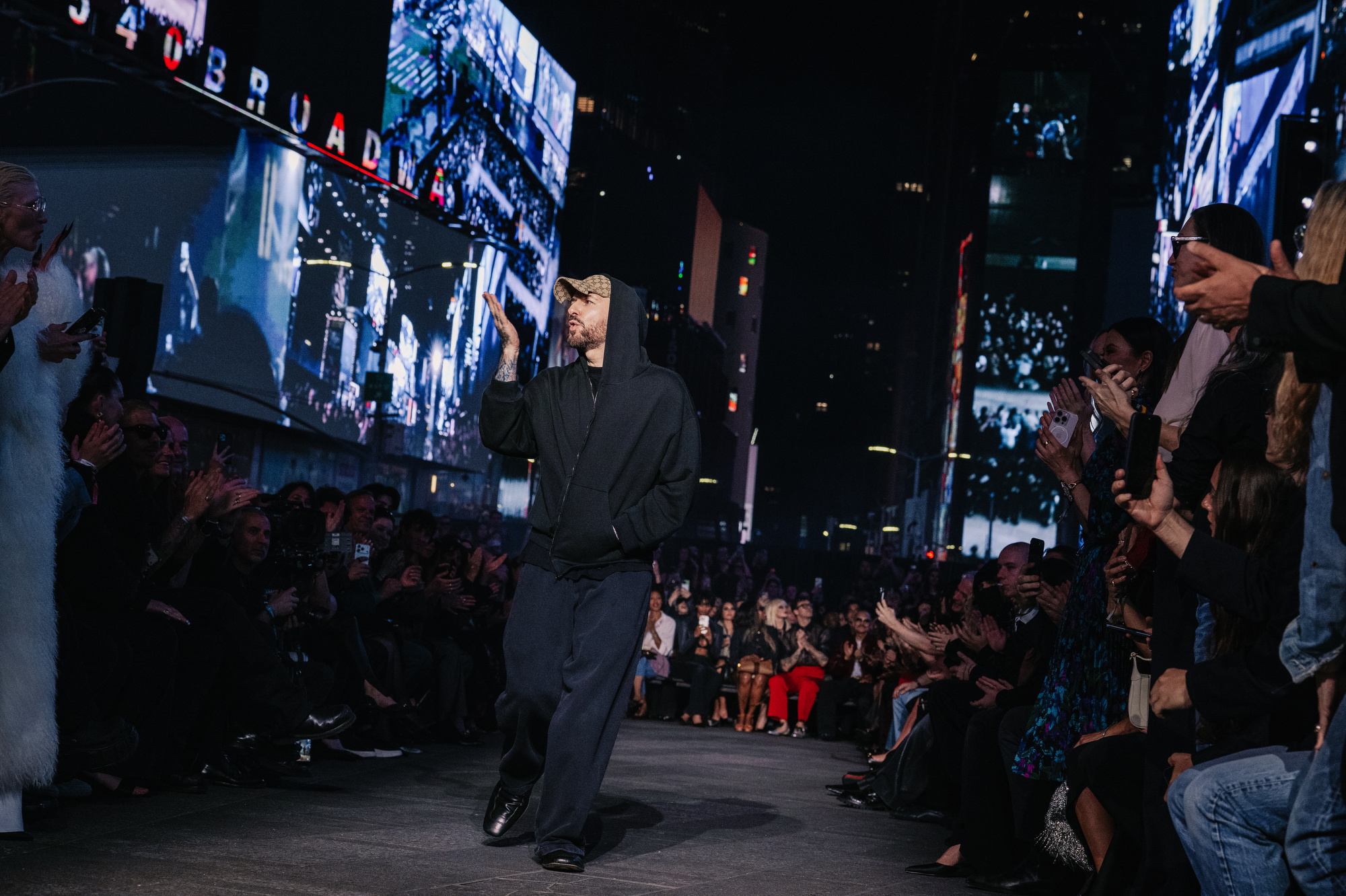
The closer is Cindy Crawford in a feather-sprigged gown. Between opener and closer, Paris Hilton and Tom Brady walked the show.
Crawford was a face of Gucci's commercial peak under Tom Ford in the 1990s; bringing her back to walk the closing slot at Cruise 2027 in the same city is a deliberate temporal loop. Demna has never closed a show with a 1990s canonical face from the house's commercial peak — that register belongs to Gucci specifically, not to his Balenciaga practice. The closer slot is where he writes Gucci rather than continuing Balenciaga.
Paris Hilton and Tom Brady walking continue the celebrity-casting logic Demna established at Balenciaga — that language is his, not the house's. Crawford in the closer slot is the house's. The show runs both simultaneously and keeps them distinct.
Opener declares the city and the brand-extension argument. Closer summons the era of Gucci's last New York commercial peak. The show opens in 2026 and closes in 1999.
The casting argument — the Tom Ford supermodel summons.
Two consecutive Gucci shows are now bookended by 1990s Gucci-adjacent commercial-peak faces — Kate Moss closed Fall/Winter 2026 ready-to-wear, Cindy Crawford closes Cruise 2027. The closer slot is being used as a canonical-face summons across collections, not within them.
Those faces are associated with the era of Gucci's greatest commercial expansion. Demna invoking them at the closing position is a casting decision specific to Gucci — a register he never deployed at Balenciaga. He is using the faces who carried that period's New York Gucci cultural authority to frame his own.
The front row was extensive and pop-cultural — Mariah Carey, Lindsay Lohan, Kim Kardashian, Shawn Mendes, Marc Jacobs, Lewis Hamilton, Lil Uzi Vert, Playboi Carti, Iman, Pat Cleveland, Bethann Hardison, Jenna Lyons, Carine Roitfeld. The mix of supermodel veterans (Iman, Pat Cleveland, Bethann Hardison) and contemporary mass-culture celebrity (Carey, Lohan, Hamilton) runs the same temporal-loop logic in the seated register: Gucci's NYC history alongside Gucci's NYC present.
Three audience tiers at one address — supermodel veterans, contemporary mass-culture celebrity, fashion industry. The brand occupies every cultural vertical at the same block of pavement, simultaneously.
The venue as the argument — Times Square, 1953, GucciCore.
Gucci shut down a full city block in Times Square. One straight north-south strip, audience seated both sides, public crowd in tens of thousands extending several blocks beyond the runway perimeter. The pre-show film broadcast on the surrounding LED billboards before the runway started opened on the Trevi Fountain in Rome — a black-and-white shot referencing Fellini's La Dolce Vita.
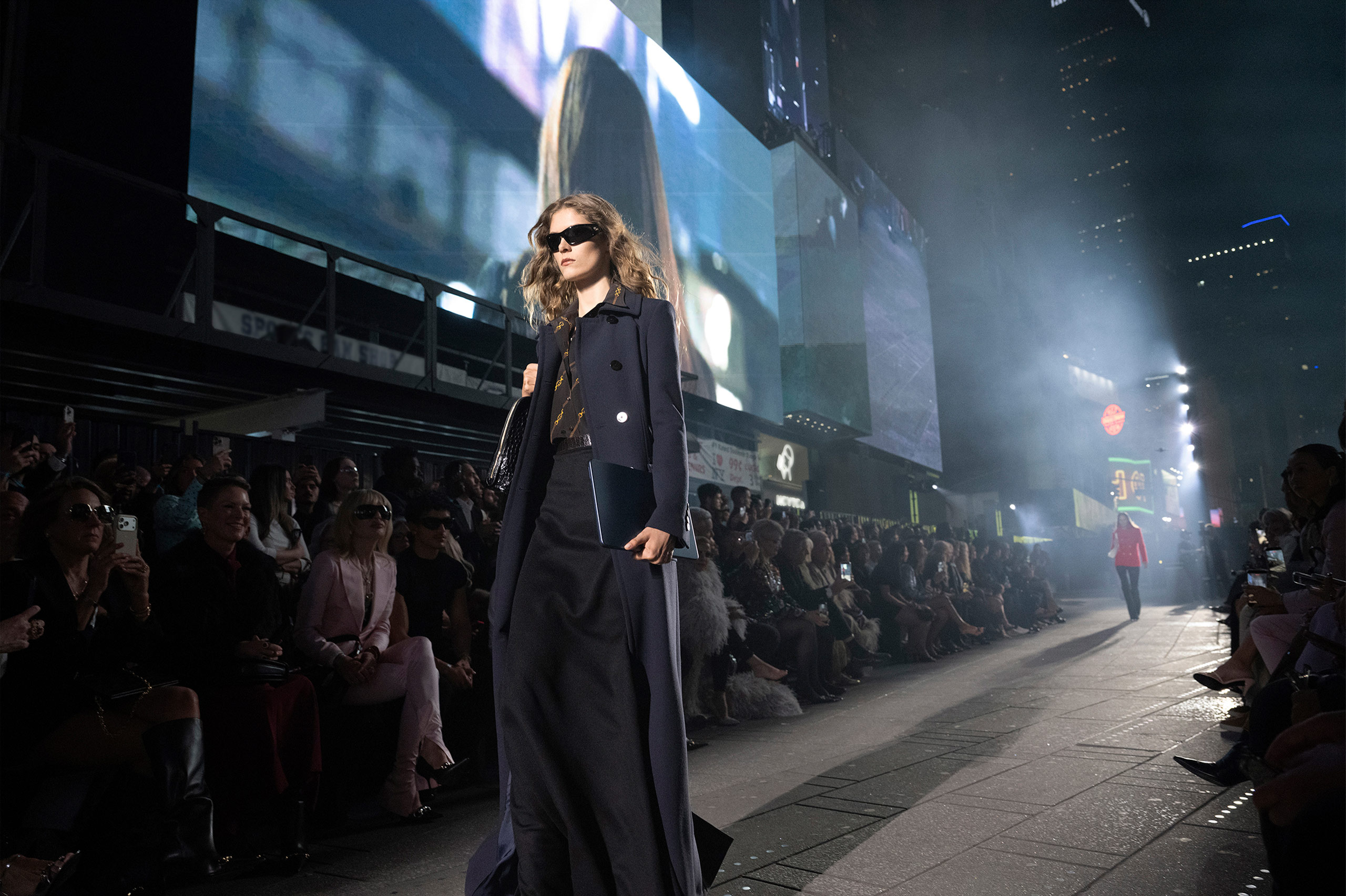
Times Square is the most commercially saturated, democratically chaotic, visually noisy square mile in the world — a place brands go for reach, not mystique. Gucci's first international store opened in New York in 1953. The 73-year arc is the historical frame: Gucci first crossed the Atlantic through New York, the city that made the Florentine craft house into an international luxury brand. The Trevi Fountain in the pre-show is the counter-geographic anchor — Italian heritage stated before the American claim. Rome before New York. Then New York.
Cruise 2027 is not Gucci arriving in New York. It is Gucci returning to the city of its original transatlantic claim — restating a 73-year argument in 2026's commercial register.
The brand film running alongside the show is titled GucciCore. It is structured as a conceptual provocation — a satirical extension of the brand into total lifestyle territory: Palazzo Gucci (luxury hospitality — "check in to a point of view"); Gucci Pets ("for the dogs and cats who accept nothing less"); Gucci Life (longevity supplements); Gucci Water; Gucci Automotive; Gucci Tech; Gucci Business. The film's tagline register is deadpan, sardonic, self-aware. Whether any of these become commercial realities is beside the point; the film's argument is the argument.
The thesis image of the season appears in both the brand film and the runway opener: the red apple with the gold Gucci oval produce sticker, carried by a body in Gucci tailoring. The brand film produces the still; the runway opener embodies it. The fashion show is not a separate event from the brand film — it is the brand film made live. Fashion runs on the same visual field as the brand-extension argument, which makes it one product in a total brand ecology, not the center of one.
Times Square was not a fashion show with a simultaneous product launch. It was a brand activation that happened to include a fashion show. The fashion industry attended a show. New York City got a product launch. The two events are not the same event.
Same-night retail — five Manhattan addresses.
New styles dedicated to the city, available at five New York locations the same night the show closed: Fifth Avenue, Wooster Street, Meatpacking, Saks Fifth Avenue, and Bloomingdale's 59th Street. The exclusive product is the Gucci NY tote, online and in hand the same night.
The five-address geography maps the Times Square argument exactly. Fifth Avenue prestige; Wooster downtown creative; Meatpacking fashion-celebrity; Saks aspirational wholesale; Bloomingdale's mass-aspirational. Every market tier covered simultaneously. After the apple, the first commercial expression of the New York claim is a tote shaped for a city that walks everywhere.
Where the show holds tension.
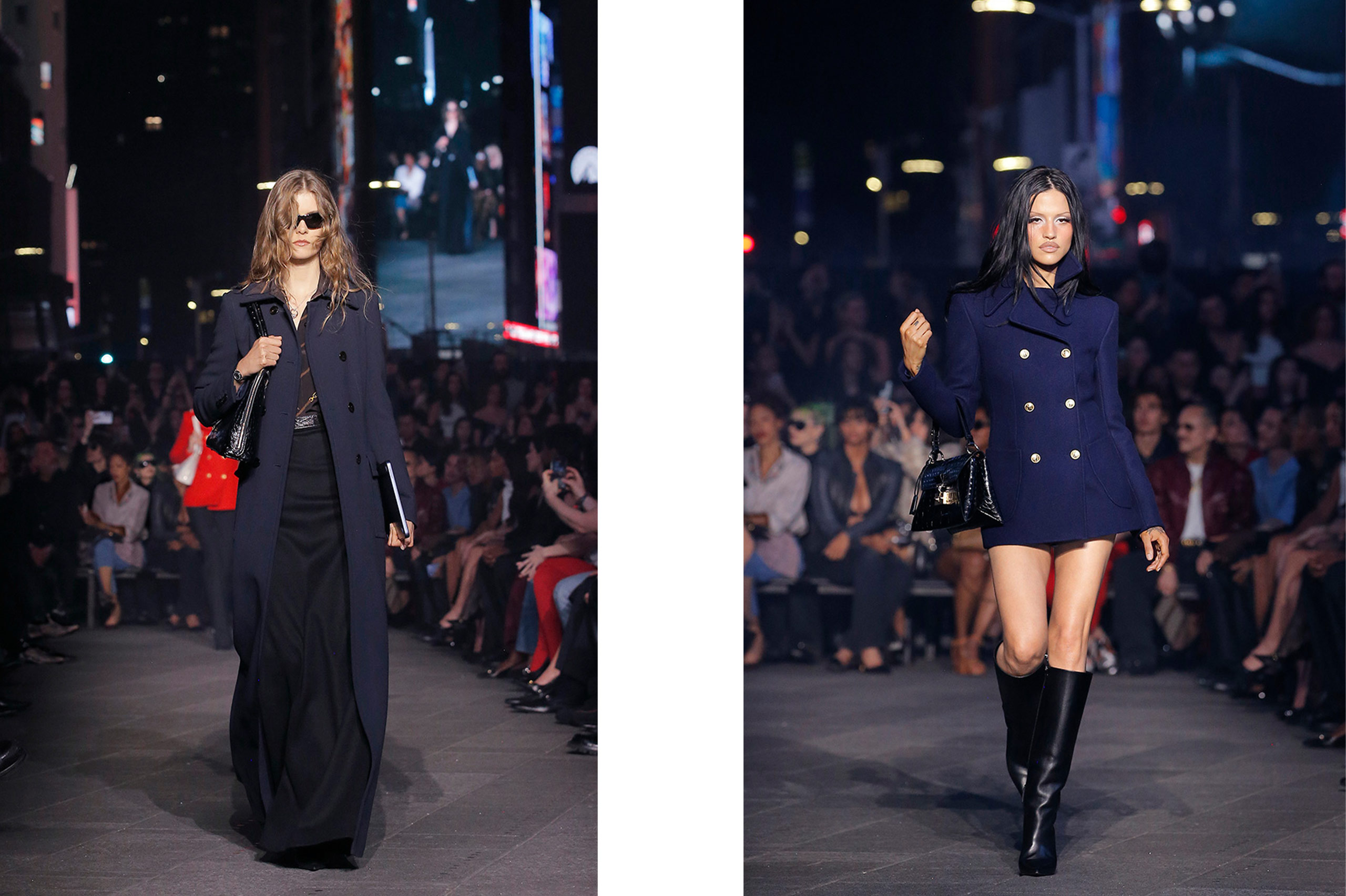
Across the confirmed looks, the construction grammar splits into roughly equal thirds. Demna ports: the straight-cut dark jeans and oversized black blazer and ribbed turtleneck and knee-high boots; the exaggerated black leather tote proportioned wider than the model's torso. Michele archive activation: the yellow satin horsebit chain-print maxi with the GG web belt, floral hem panel, and pussybow neckline. Tom Ford body-consciousness: the black bustier with low-rise flared trousers; the rust draped jersey maxi.
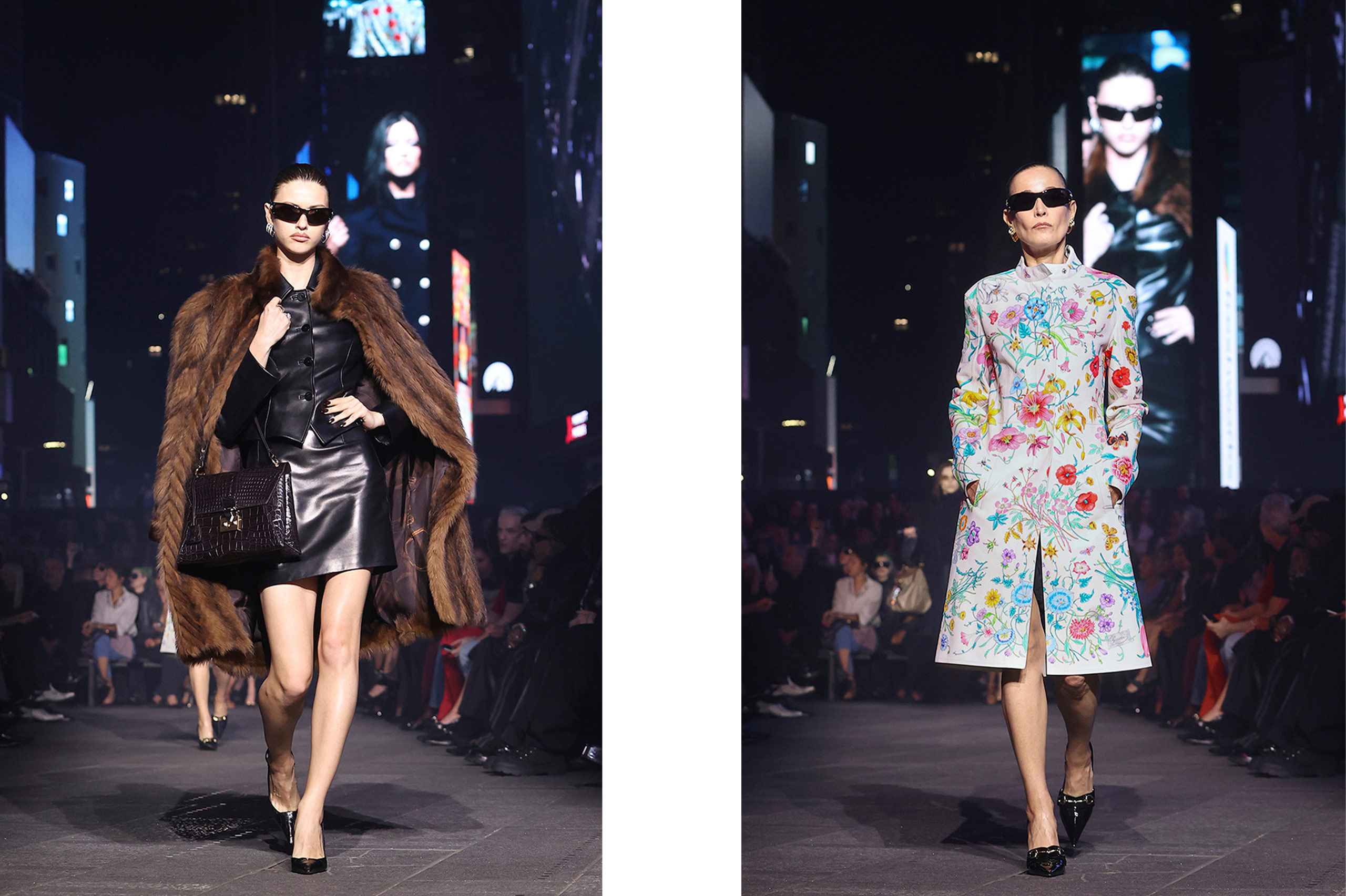
The Demna ports are deliberate signature transfers — the jeans-blazer-knee-boot combination has appeared in roughly every Demna Balenciaga collection since 2017. The Michele activation is pure surface-decoration archive. The Tom Ford echo is body-consciousness restated in a 2026 register.
This is a CD demonstrating he has read the house, not yet asserting what the house becomes under him. He is not writing Balenciaga 2.0 on Gucci's body — that is the professional achievement, and it is real. The creative question — what does Gucci become under Demna that it could not be under anyone else — is the question the equal-thirds synthesis declines to answer.
Alessandro Michele's Gucci had a dominant look. Tom Ford's Gucci had a dominant look. Demna's Gucci, on its first Cruise, does not yet.
The positioning read.
Three Gucci eras, one city, same address. Gucci first crossed the Atlantic through New York in 1953. Tom Ford's Gucci peaked commercially in 1990s New York. Demna's Gucci stages in Times Square in 2026, opens with the city's symbol carried in a hand, and closes with a face who walked that peak. The argument being made is continuity of commercial authority across seven decades.
What the show cannot claim yet is continuity of creative voice. The brand is authored — GucciCore is specific and deliberate. The casting is authored — the canonical-face summons across consecutive shows is a considered position. The clothes are not yet authored.
Gucci under Demna is moving from Recognized toward Authored. The brand made that move on 16 May. The fashion line is still in transit.