Dior.
Not a new direction. A documented one, recovered.
Anderson's first Dior Women's Cruise has a title: Wilshire Boulevard. The collection is 75 looks across men's and women's — the first mixed-gender Cruise in Dior's format. It stages inside LACMA's David Geffen Galleries (Peter Zumthor, opened 2026) on a reproduced Los Angeles intersection, with a fleet of vintage Cadillacs color-coded to the collection's palette entering and exiting the runway. The load-bearing move is archival: Anderson recovers the 1949 Bar jacket Christian Dior made for Marlene Dietrich in Hitchcock's Stage Fright. The prototype had been held in the Alaïa archive until this year. Anderson is not announcing a new direction at Dior. He is reactivating a documented one.
The opener and closer as the argument.
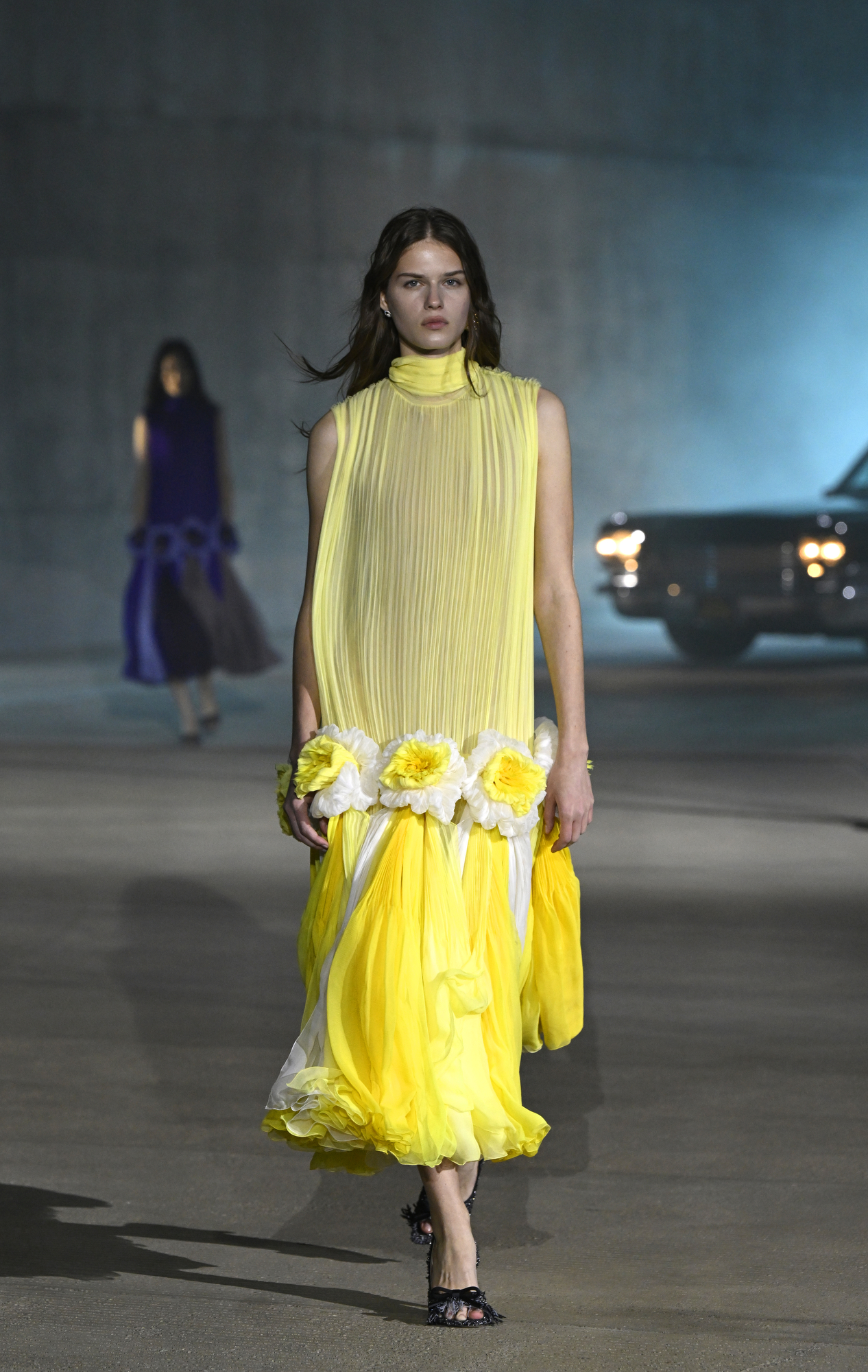
Look 1: a sheer primrose-yellow gown, pleated, scattered with oversized rosettes. Sabrina Carpenter sat in the front row wearing the same look — the opening garment and the most photographed person in the room in identical dress simultaneously. The opening look is not a runway decision. It is a declaration about where the front row sits in relation to the show.
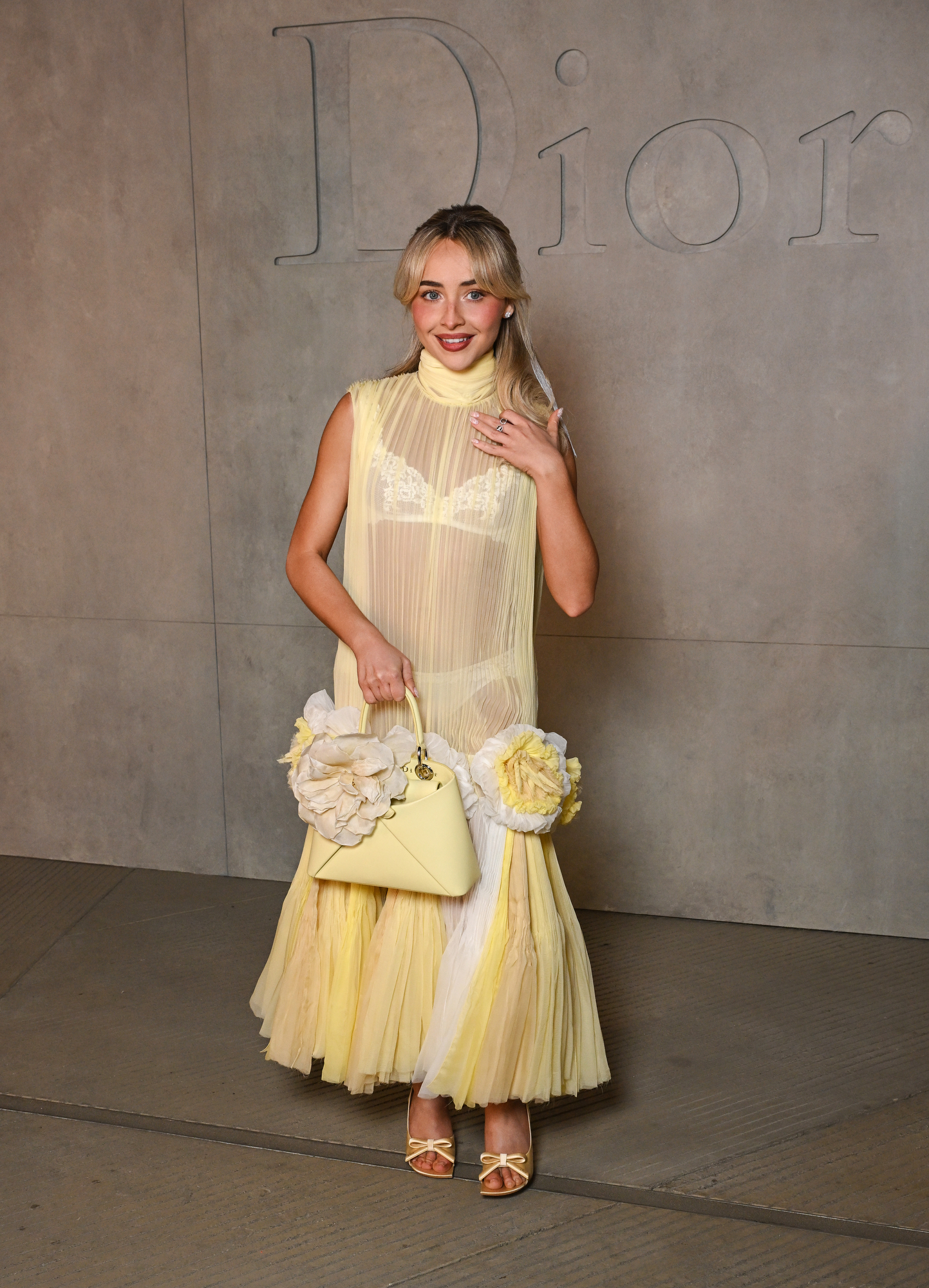
At Loewe, Anderson's openers were models. His pop-cultural cameos were campaign moves, not runway. Dressing Carpenter in Look 1 and placing her in the front row in the same garment is a register he did not use at Loewe — it is the use of Dior's specific Hollywood permission. The house has that permission because it contracted for it in 1949. The opener activates it.
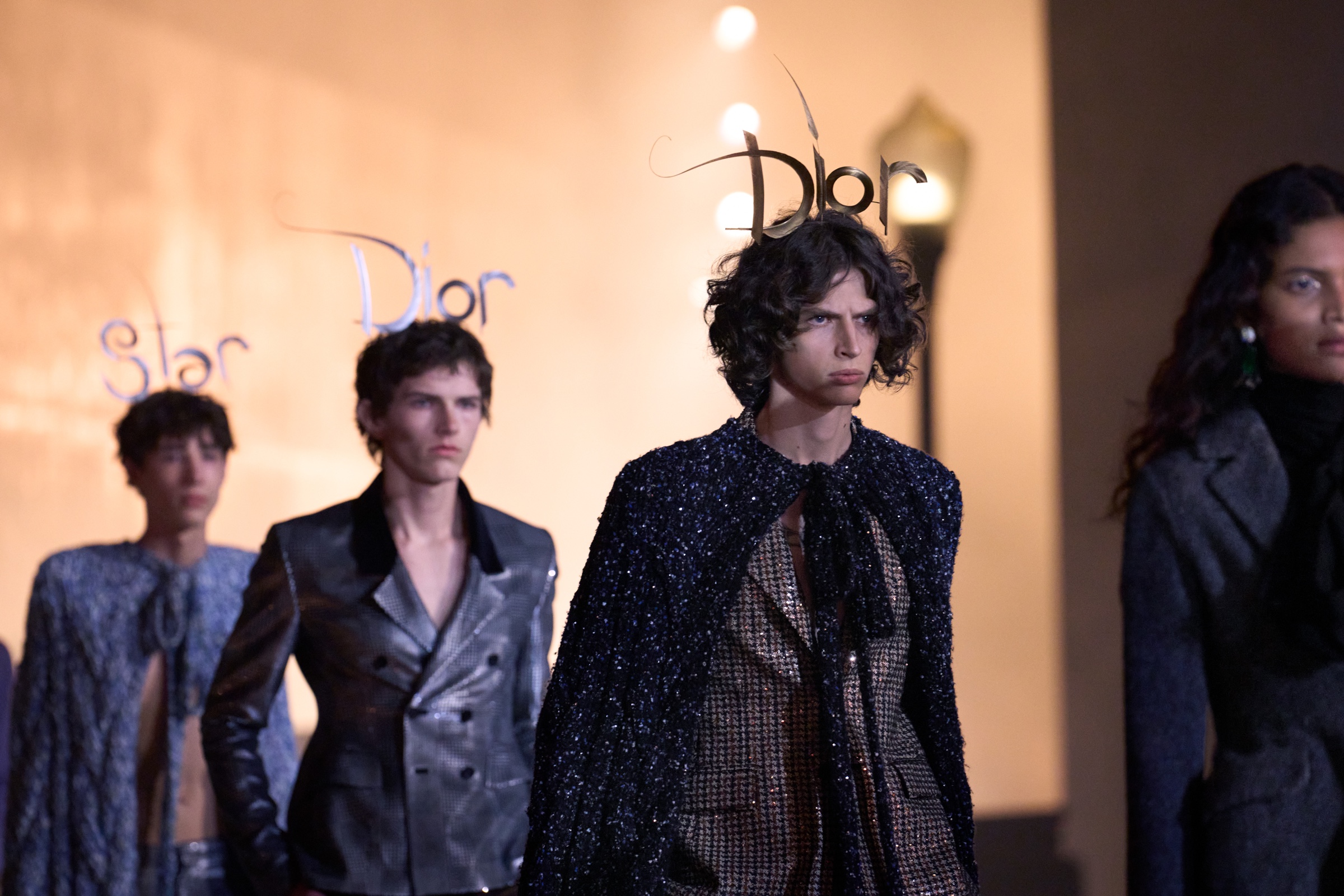
The closing sequence was male models in elaborate constructed looks — sparkly navy textured capes with bow ties, silver metallic double-breasted blazers with velvet collar, heavy blue tweed capes — walking to Air's Kelly Watch the Stars. The backdrop shifted to warm amber; STAR and DIOR visible in the handwritten headpiece script. The absolute final look: a male-presenting model in a dark charcoal tweed suit — cropped jacket, wide-leg trousers, white socks — carrying a large houndstooth bag, under the word BUZZ. No couture gown. No spectacular finale. The show closes with the community, not with femininity. That is the gender dissolution argument made visible in the final image of the night — and it required no announcement to land.
Anderson walked his bow in a black-and-white plaid flannel shirt, pale flared jeans, and dark boots alongside the cast, around the Cadillac at the intersection's center. The bow look is not generic working-designer wardrobe — it is specifically California working wardrobe. Plaid flannel, flared denim, dark boots: the register of the state the collection is named after, worn by the CD on the night he names it. He bows in the clothes he is proposing the house should speak.
The casting argument — Brokaw, scale, and the gender boundary.
Casting director is Ashley Brokaw — a long-time Anderson collaborator from his Loewe years, not the team that carried Loewe. The cast runs 75 looks across men's and women's. Soo Joo Park is confirmed among the walkers. Male-presenting models walked alongside female models without annotation or editorial framing.
Brokaw's book — Prada, Proenza Schouler, Ghesquière at Louis Vuitton — runs at the operational volume Loewe Cruise shows never approached. Anderson's Loewe casting grammar (sculptural unknowns, specific presence over conventional beauty, a range of ages, gender-inclusive logic) was developed at lower scale. The Dior platform requires different operational logic, and Anderson has appointed someone he has worked with before, recalibrated for the scale.
Two structural moves in one casting decision. Anderson is not importing his Loewe infrastructure wholesale; the casting is Dior-calibrated. And gender dissolution at Dior Women's is consistent with Anderson's Loewe grammar but materially more visible at this scale and inside this house. The cast reads as a community, not a unified type. There was no announcement around the gender inclusion. There is no language around it. It simply happened.
The front row is pop-cultural, not fashion-industry — Al Pacino, Miley Cyrus, Anya Taylor-Joy, Jisoo, Sabrina Carpenter, Jeff Goldblum, Macaulay Culkin, Miranda Kerr, Tracee Ellis Ross. This is not contemporary celebrity casting. It is the documented Dior-Hollywood archive activated — Christian Dior dressed Dietrich, Bergman, Hepburn, Grace Kelly, Monroe, Gardner. The cinema permission is original to the house.
The ambassador roster Anderson has built over the past year (Josh O'Connor, Drew Starkey, Taylor Russell, LaKeith Stanfield, Florence Hunt, 070 Shake) carries the under-35 cultural layer; the front row carries the institutional Hollywood layer. The two halves are speaking the same language for the first time since Chiuri's departure.
The closing sequence makes the casting argument explicit. Eight male-presenting models walked the final circuit together, each wearing a small handwritten-script headpiece — wire-crown structures spelling DIOR, STAR, FLOW, BUZZ. Only male-presenting models wore the word headpieces across the entire show. Anderson is putting the conceptual vocabulary of his Dior on male bodies. The intellectual architecture of the house — the name, the cinema, the movement language, the cultural attention — is worn as a crown by men.
One look makes it without ambiguity: male model in open brown tweed blazer, chest bare, wearing a floor-length garland of mixed flowers — carnations, hydrangeas, roses in pink, white, orange, lavender — cascading from shoulders to hem, the FLOW headpiece above. Dior couture craft applied to male adornment, not construction. The word and the literal expression of it on the same body. This is what culture-watch exists to read — not the flower garland as an aesthetic choice, but as the precise signal that the house's craft language has moved to include male bodies as its subject, not its margin.
The venue as the argument — Wilshire Boulevard, LACMA, Stage Fright
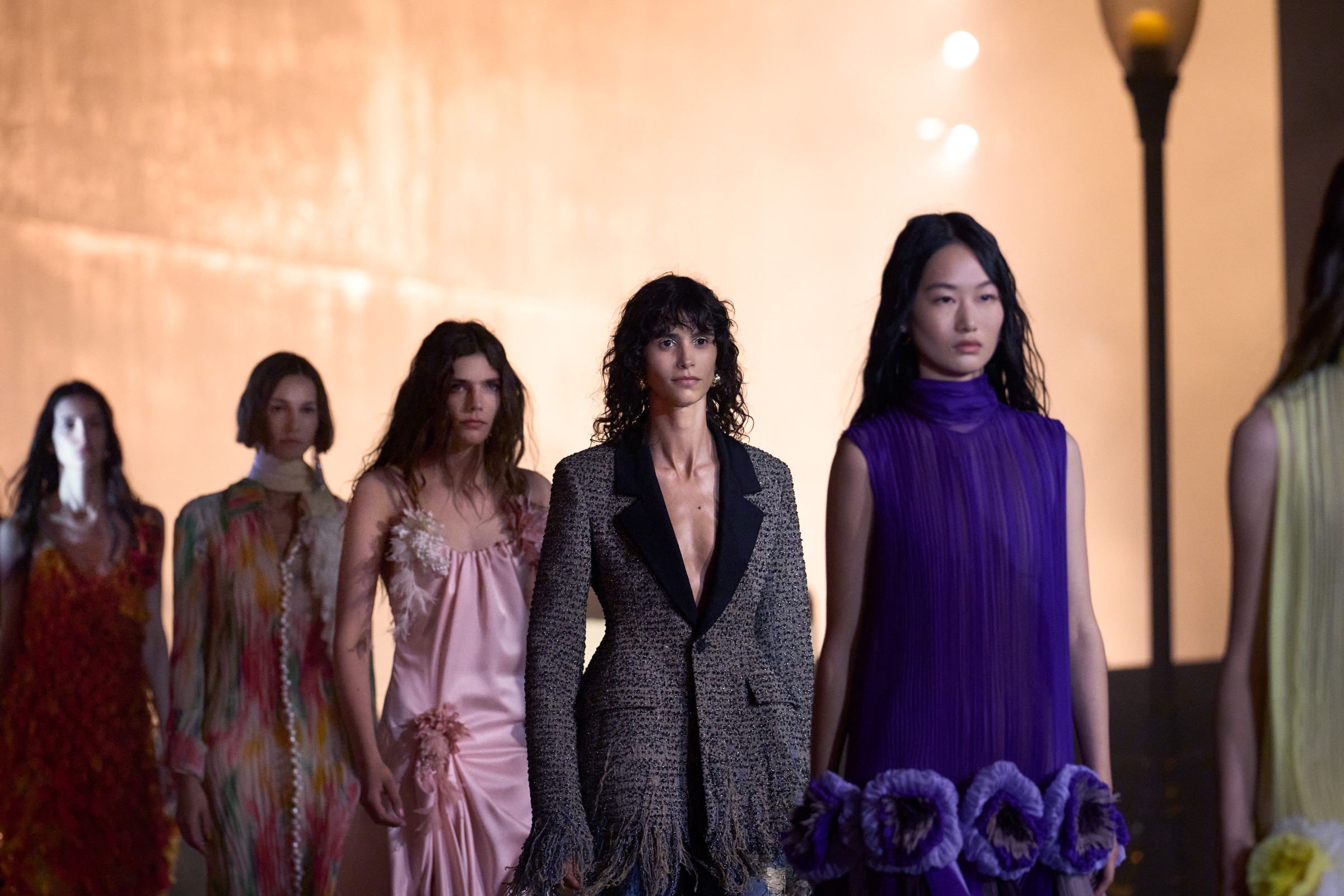
The collection is titled Wilshire Boulevard — not a concept, a street. The venue is LACMA's David Geffen Galleries (Peter Zumthor, opened 2026 — the most consequential American museum commission of the decade). Anderson built a Los Angeles city block inside the museum: real intersection, street lamps at corners, vintage Cadillac fleet color-coded to the collection's palette (dusty rose, chartreuse, scarlet, champagne) entering and exiting throughout the show. Fog in the final sequence. Models' shadows projected at architectural scale across the Zumthor travertine.
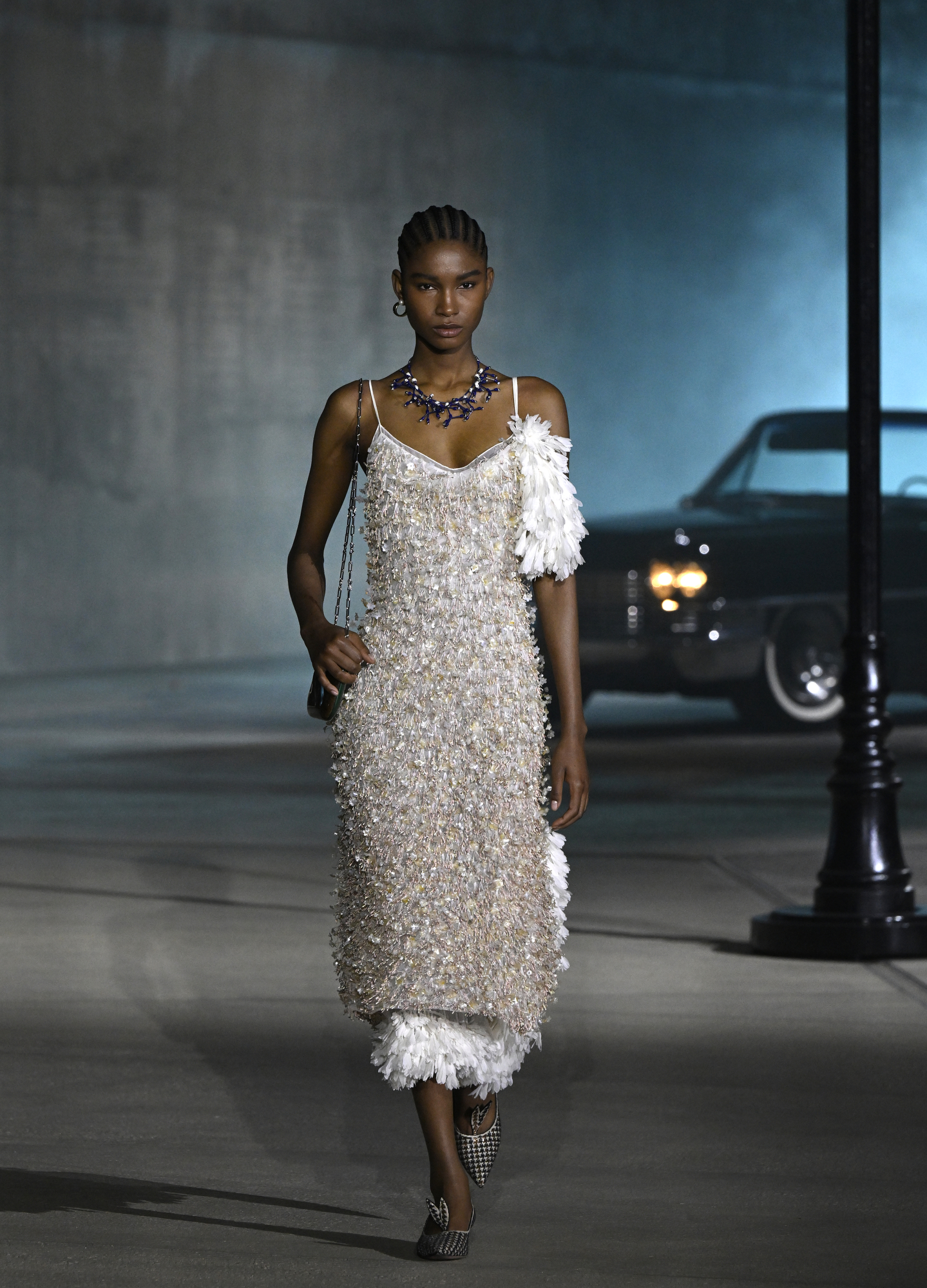
Christian Dior dressed Dietrich for Hitchcock's Stage Fright (1950) — the stipulation was that Dietrich would not take the role without a Dior contract for her wardrobe. The house dressed Bergman, Hepburn, Kelly, Monroe, Gardner. Anderson is not reaching for a Los Angeles connection. He is activating an original archive that has existed since 1947, the year of the New Look and Christian Dior's first California trip.
The Los Angeles claim is contractual, not aspirational. By titling the collection after a specific street and staging it inside Zumthor's new institutional building before almost any major fashion show has occupied the space, Anderson plants Dior inside a Los Angeles cultural institution at the moment of its own opening. The house arrives before the building has a fashion history, which means it writes one.
Anderson recovered the 1949 Bar jacket Christian Dior made for Dietrich in Stage Fright. The prototype had been held in the Alaïa archive until this year. It appears across the 75-look lineup — stretched, fringed, recut with men's tailoring. The Bar jacket is the most archive-loaded garment in the Dior vocabulary; every CD transition has touched it. Anderson chooses the 1949 cinema prototype specifically — the object that documents Dior's first encounter with Hollywood. The Cadillac fleet, the noir lighting, the Hollywood front row, the Ed Ruscha shirt collaboration that roots the collection in California's visual culture rather than its mythology, the Guadagnino documentary now in production — all of it traces back to Stage Fright and the 1949 Bar jacket. The concept and the archive are the same object.
Same-night retail — the absence is the signal.
No same-night retail activation. No Cruise capsule on dior.com timed to the show. The commercial spine of the collection — Saddle bag revival, crescent hobo across at least four colourways, Ed Ruscha word-shirts, 3D floral corsage motif — is present in the work but not activated as immediate purchase. Seat gifts: Dior blankets and a mock film script titled Wilshire Boulevard.
The Saddle bag revival is Anderson recovering one of Dior's most-recognised shapes and reframing it for his Dior — the heritage commercial argument. The crescent hobo (tan/nude, olive/khaki, aubergine, mustard, with gold chain hardware as the consistent signature) is the next-generation play. The film-script gift is a concept object: a script is something you read, not something you buy.
Anderson treats the show as a cinematic event, not a commercial activation. Desire-formation happens at the show; conversion follows the rhythm of the house, not the demand of the digital window.
Where the show holds tension.
Destroyed denim appears as a sustained sequence — ripped jeans with a camel blazer and trainers; plaid flannel with wide-leg destroyed denim and an olive crescent hobo; male-presenting model in white shirt open at the chest with ripped dark jeans. It is not one look. It is a system.
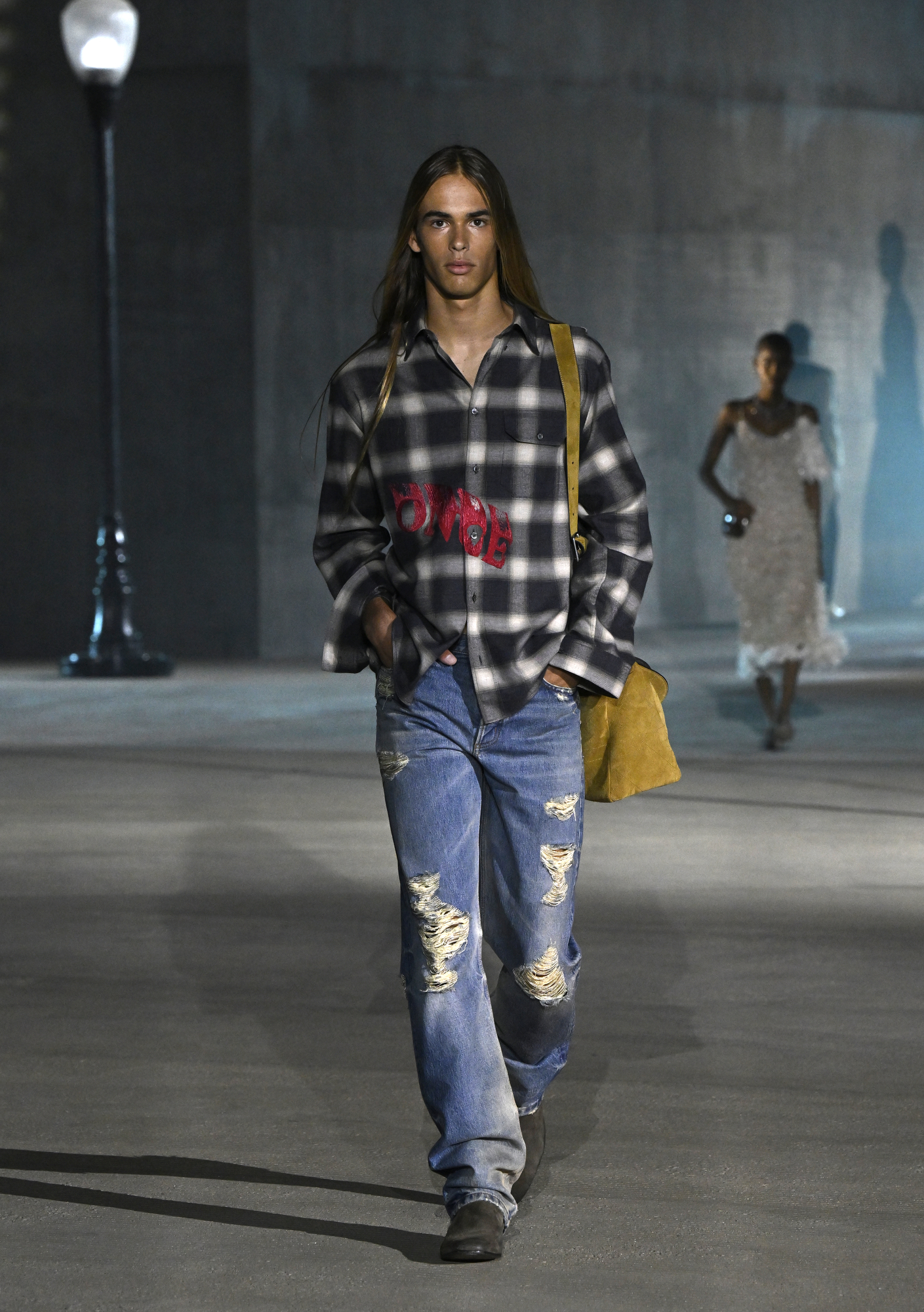
No Women's CD before Anderson has used destroyed denim as a considered collection system at Dior. Not Chiuri. Not Raf. The house has shown volume, severity, femininity in various registers — but destruction in denim, sustained across multiple looks, is a first. The rupture is placed inside the heritage account base, not adjacent to it. The cuts are architectural; this is denim as craft, not denim as cultural shorthand.
The Dior customer Anderson is building — the O'Connor, Starkey, 070 Shake under-35 ambassador layer — already lives in denim. The denim move is calibrated for that customer's eye, executed in the house's craft register. It is a section of the collection, not the whole. But it is the section against which everything else in the show has to be read.
The positioning read.
Anderson's Dior is built on recovery, not invention. The 1949 Dietrich Bar jacket. The original Hollywood contract. The founding California trip. The Alaïa archive opened. Every major structural decision in this collection traces back to something Dior documented between 1947 and 1950 — and then the house moved on from, and then no subsequent CD returned to.
What distinguishes this from standard archive-revival practice is that Anderson is not quoting the archive selectively. He is staging the archive as the whole argument — venue, casting, wardrobe, commercial spine, the bow in jeans. The 75 looks including destroyed denim are not departures from the archive argument; they are what the archive argument makes possible when you apply it forward rather than backward.
No prior CD transition has used Stage Fright as the structural anchor. Anderson is. That is the positioning Dior is staking — not a new California direction, but the original one, recovered from the moment before it became mythology.