Chanel.
The Coco archive, read.
Blazy's first Cruise for Chanel files three structural moves under one location. The collection — 79 looks shown at the Casino Municipal de Biarritz — opens with a reworked 1926 LBD and closes with two mermaids on the Casino floor: Noor Khan in a turquoise Lesage-embroidered sequinned fishtail gown, Josephen Akuei in iridescent scales, both with wet-bedraggled hair as if drawn from the Bay of Biscay. Two blocks from the casino, Blazy reopened the Villa de Larralde — Coco Chanel's actual 1915 couture house — as an ephemeral summer boutique. Casting director Anita Bitton runs a professional-model-only runway against a galactic celebrity front row. The argument is archaeology, not mythology.
The opener and closer as the argument.
Look 1 is the 1926 LBD reworked — the garment historically known as "Chanel's Ford," a single practical thing made for everyone, the drop-waist that made modernism wearable for women who wanted to move. The closer is the mermaid sequence: Khan and Akuei on the Casino floor in Lesage fishtail gowns, with amber raffia in the same closing register. Raffia is Biarritz vocabulary, not Paris vocabulary. Tweed appears only mid-show, not at structural positions.
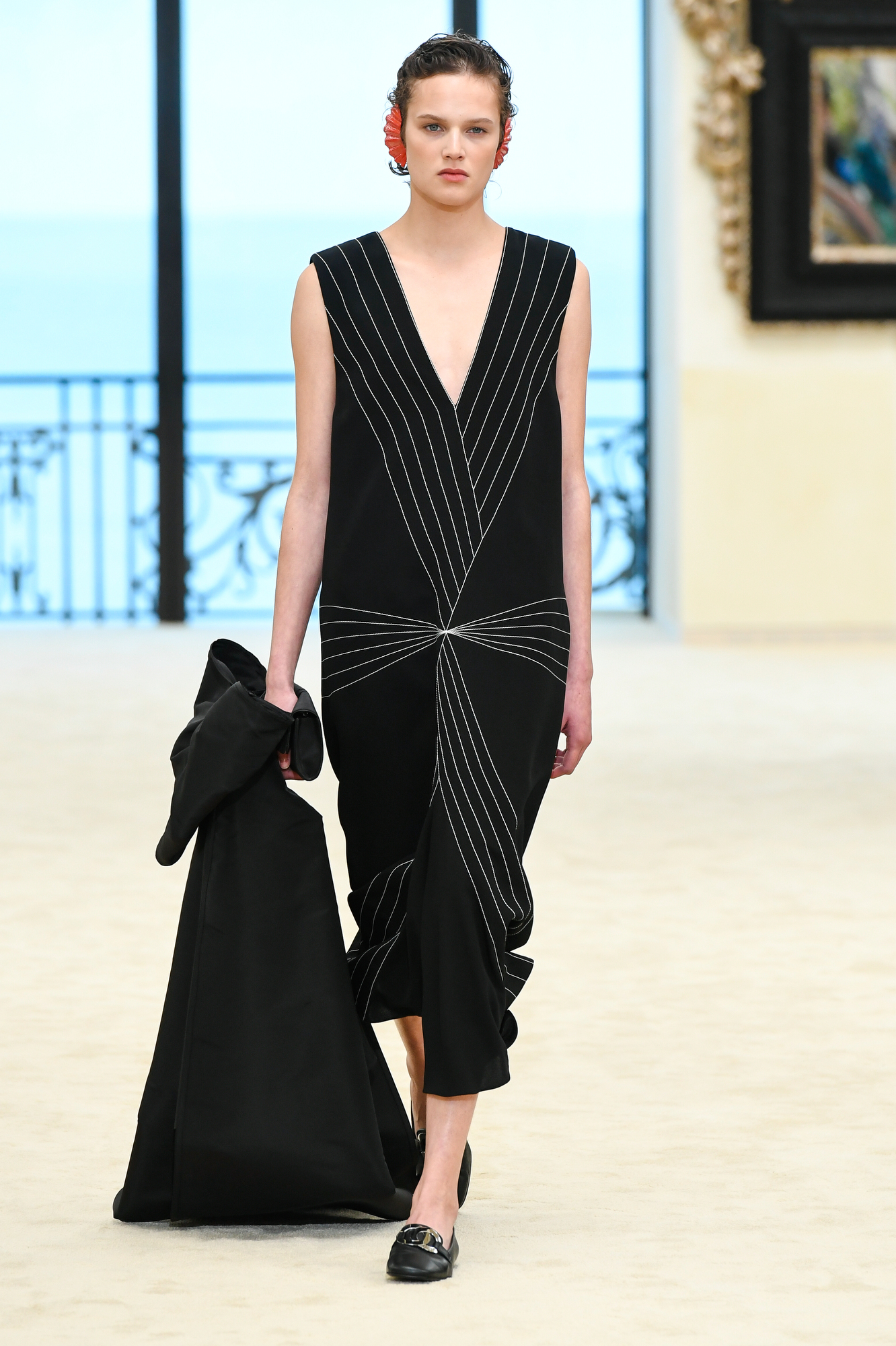
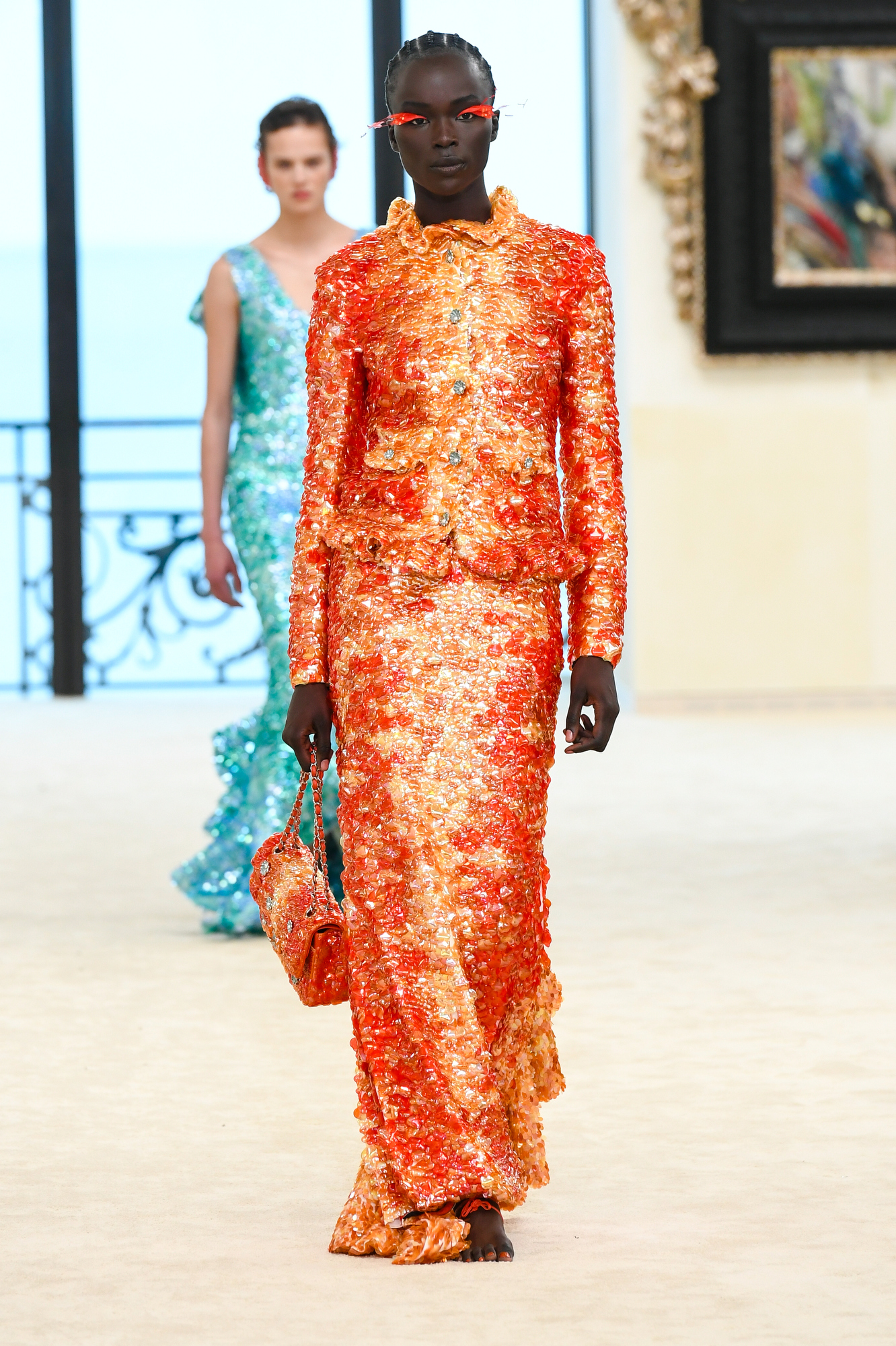
The bookends name the collection's poles. The 1926 LBD is Gabrielle's first pragmatism — a garment that existed before the mythology around it. The mermaid sequence is the Bay of Biscay rendered as the body. Blazy is not opening with the Chanel he inherited; he is opening with the Chanel that existed before the house became what it became.
Noor Khan carries the collection's arc: she starred in the pre-show teaser film as a sea creature moving through Biarritz, then closes the runway in the same register. Blazy has established this pattern across all three Chanel shows — Bhavitha Mandava built through Métiers d'Art before opening FW26; Awar Odhiang closed FW26; Khan is the face of this collection. The casting builds a through-line across shows, not within them.
The casting argument — Anita Bitton, professional-model-only at the celebrity address.
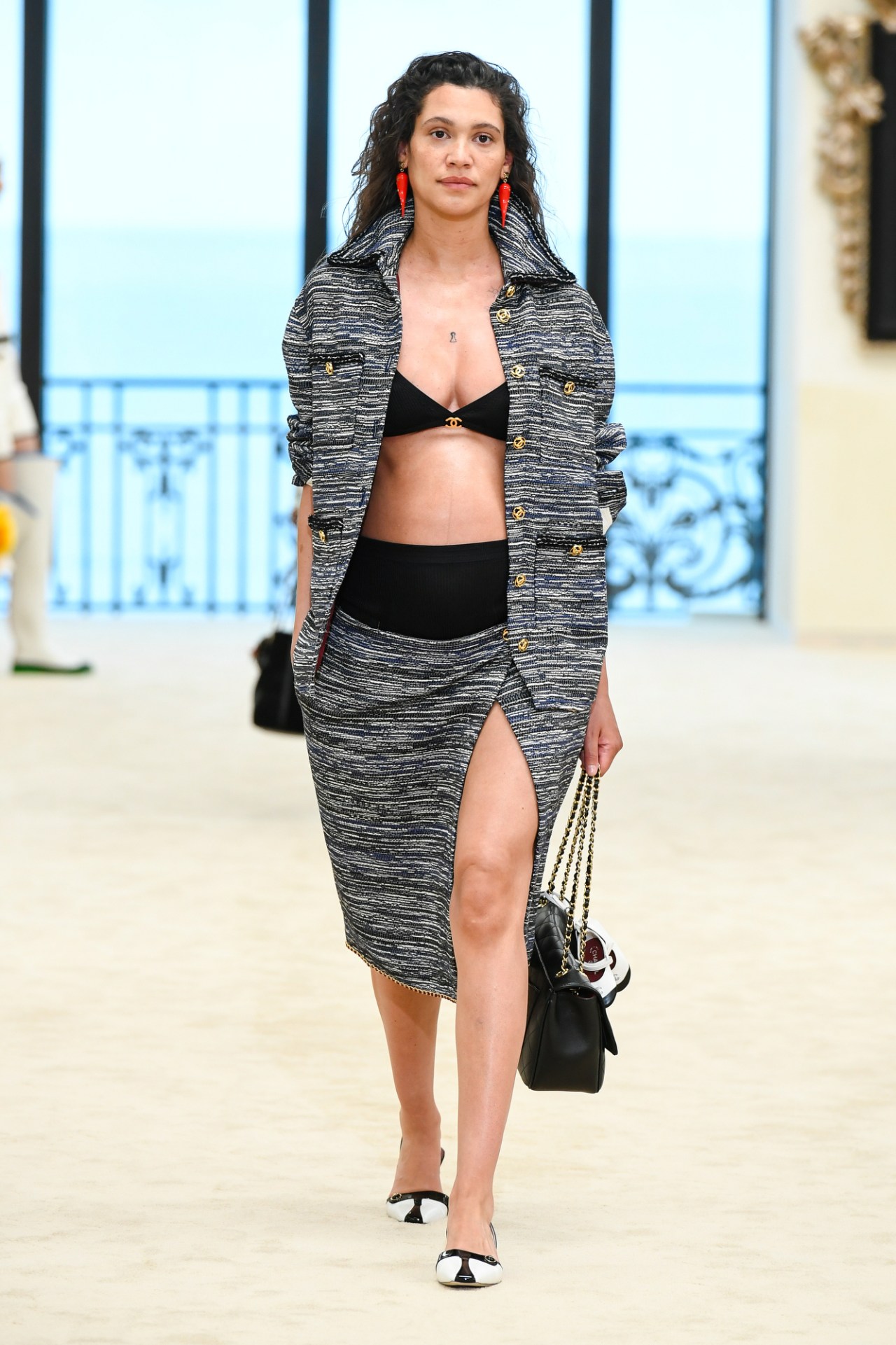
Anita Bitton has worked with Blazy since his Bottega Veneta tenure. The runway is professional-model-only: Noor Khan, Josephen Akuei, Mona Tougaard, Kaya Wilkins — Wilkins five months pregnant, in a bikini top with a tweed skirt suit and baby-shoe charms on her bag. The cast runs across age, body, background, and life stage at notably higher diversity density than prior Blazy Chanel shows. The celebrity front row is galactic — Kidman, Cotillard, Casiraghi, A$AP Rocky, Swinton, Coppola, Coel, Vartolomei, Elsesser.
At Bottega, Bitton's casting with Blazy was atmospheric restraint: sculptural, professional-first, with celebrity walkers used sparingly and only as craft anchors — Salma Hayek closing FW23 was the famous exception, there as a leather-goods argument, not a fame argument. At Chanel the gravitational pull toward celebrity walkers is structurally enormous — the house has decades of celebrity-inflected runway practice. Blazy and Bitton have refused at every show since his arrival. The refusal is now a position, not a decision.
The structural read: Blazy is not casting for inclusion — he is casting for completeness. The Chanel woman across every life stage in the same room. None of the women carries the argument individually; the range is the argument. The historical move beneath this is a return to Gabrielle's original premise — the woman who refused a single silhouette: sportswoman, lover, working woman, older woman. Karl ran archetypes in rotation across thirty years; Viard narrowed to one register; Blazy refuses the rotation entirely.
The venue as the argument — Casino Municipal, Villa de Larralde, 1915.
Casino Municipal de Biarritz — Art Deco seafront casino, mirrored salon extending over the Atlantic, the ocean visible through the windows behind every exit. Two blocks away, Blazy reopened the Villa de Larralde — Coco Chanel's actual 1915 couture house, now a bookstore the rest of the year — as an ephemeral summer boutique. This is not a metaphor. It is an operational decision.
Coco Chanel opened her first couture house at the Villa de Larralde in 1915, funded by Arthur "Boy" Capel. Biarritz was where the Atlantic clients had escaped during the First World War — the Spanish aristocracy, the resort set, the women who needed clothes that could move. Here Coco introduced jersey into haute couture and proposed that elegance could follow the body rather than restrain it. This is the earliest Chanel address: not Rue Cambon (the boutique, 1910), not Deauville (the sportswear shop, 1913). The first couture house. 111 years exactly.
Cruise as a season is often treated as the commercial interval between RTW. Blazy refuses this. He stages at the founding address and reopens the actual founding building as a commercial presence. Blazy is not claiming Karl's Chanel — the rotating references, the spectacle, the mythology that eventually became the brand. He is claiming Gabrielle's Chanel: the 1915 Atlantic version, where elegance was a practical problem solved with jersey and good sense. The Métiers d'Art 2027 announcement for Rome extends the same logic: each cardinal collection moment anchors to a Chanel origin geography.
Same-night retail — the absence is the activation.
No same-night retail. No buy-now mechanism, no limited-edition drop, no online capsule timed to the show. Instead: the Villa de Larralde ephemeral summer boutique, a continued Biarritz Film Festival partnership extending the house's presence in the city across weeks, and the Métiers d'Art 2027 announcement for Rome.
Chanel boutiques cannot keep Blazy's clothes in stock — demand is structurally outpacing supply across his first three collections. The commercial pressure is removed from the show itself because the conversion pipeline is already overheated. The show does not need to function as a conversion event.
The absence is the structural position. Chanel under Blazy is operating brand-as-archive, not brand-as-drop. The activation is slow and place-based — visit Biarritz over the summer, enter the Villa de Larralde, receive the clothes when they arrive. The scarcity is structural. The patience is the position.
Where the show holds tension.
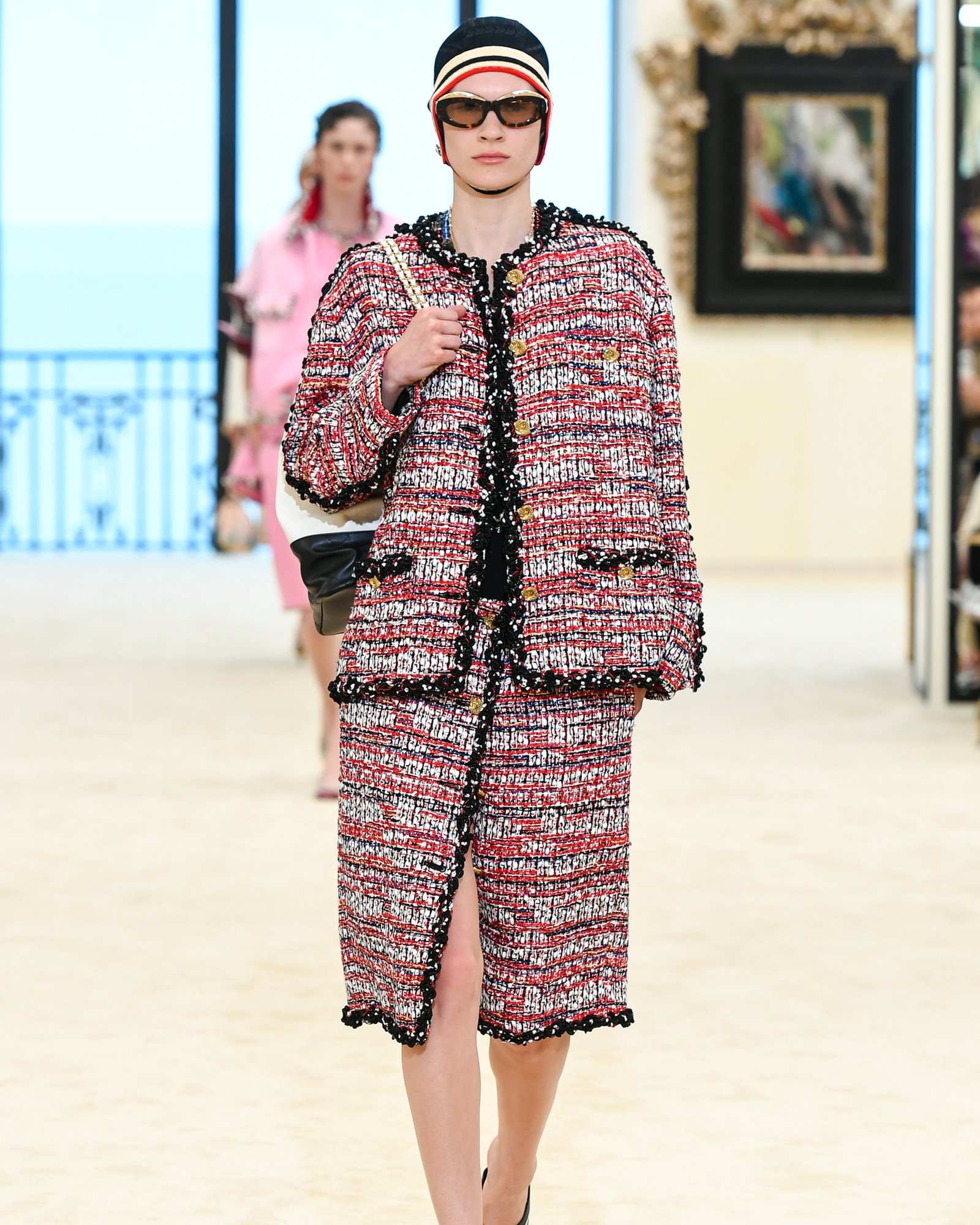
The red-and-white CC swim cap stripe — a long coat-dress with the CC monogram integrated into the stripe repeat, worn with a matching swim cap pulled as a hood. This look does not exist to sell. It exists to anchor — to give the rest of the collection a reason to be here rather than anywhere else. Blazy is not quoting Biarritz; he is constructing a specific visual language for Chanel at Biarritz, precise enough to anchor a second collection here.
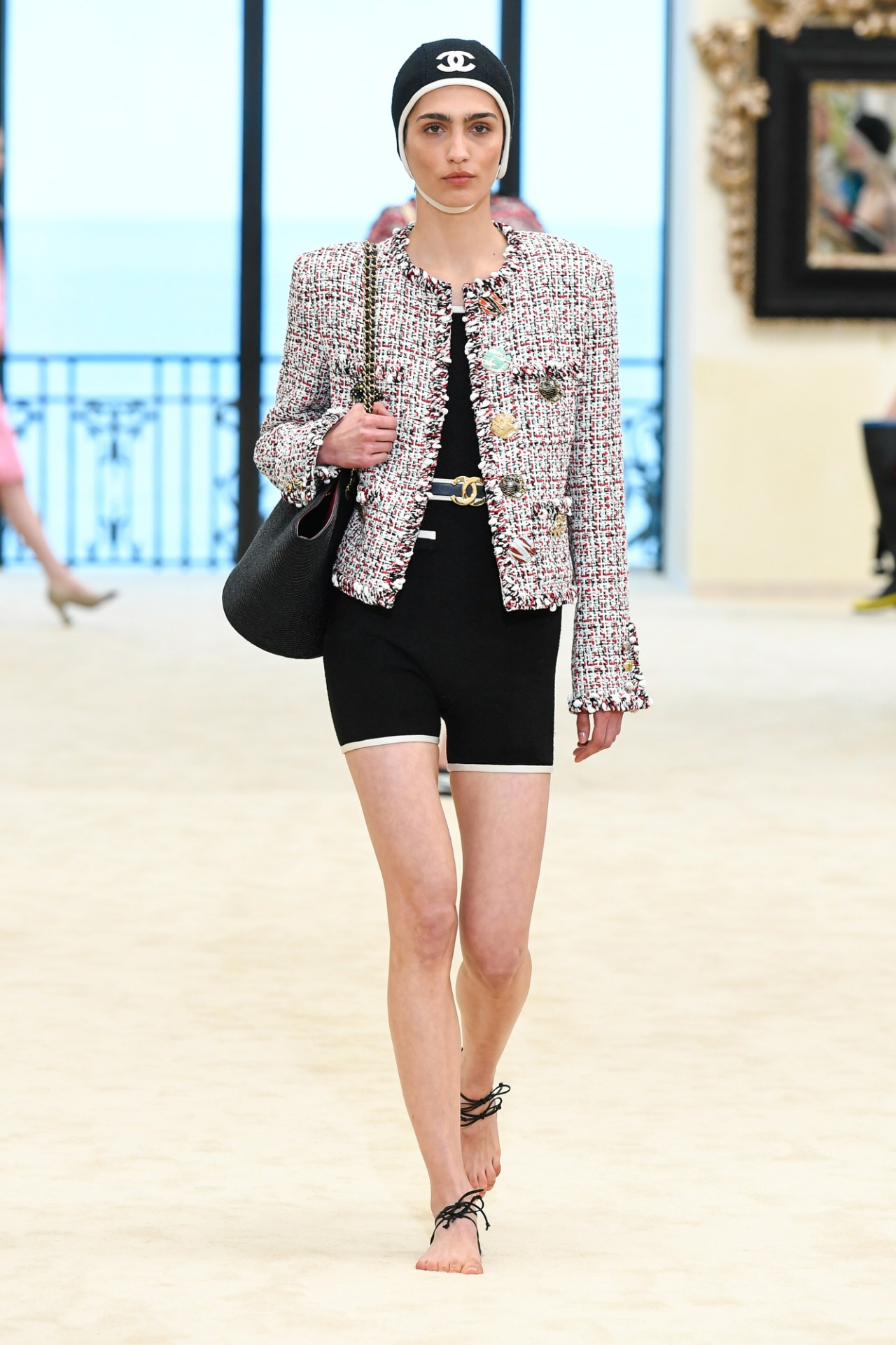
The structural tension across 79 looks: exact reproduction of Gabrielle's archive — the 1926 LBD, lost 1920s skirts with double-C logos reproduced from 1929 sketches, garments where the CC emblem functions as the construction itself — sits alongside Blazy's own developing Chanel language. The archive is doing as much work as Blazy in the middle of the show. When a lost 1920s skirt is as modern as anything else in the collection, the tension is not a failure of vision; it is Blazy testing how much of the house's original language holds without his intervention. The mermaid sequence is where he answers the test — pure Blazy invention applied to Chanel craft.
The logo conversion names the shift cleanly. Blazy at Bottega worked four years with no logo, pure intrecciato. At Chanel, the double-C taken from 1929 sketches and made into the whole garment is not streetwear logomania. It is archive logomania — the emblem that predates the commodity, restored to a position before it became ubiquitous.
The positioning read.
Three shows into his tenure, Matthieu Blazy is making Cruise the serious collection — not the corrective collection, not the commercial pause. The season where the foundational argument gets stated in the place where the foundation was laid.
The positioning Blazy is staking is Gabrielle's, not Karl's. The house has been sold on Karl's Chanel for forty years — the rotating mythology that eventually became the brand. Blazy is going upstream of that mythology to the practical intelligence that preceded it. The 1926 LBD already knows what it is. The 1915 Villa de Larralde already knows where it stands.
The show does not ask to be compared to prior Chanel. It asks to be read against 1915. That is a different ask — and three collections in, the market is beginning to answer it.